Goal
Site 2 should not be a random second network. It should mirror the Site 1 pattern so routing, firewall policy, automation, monitoring, and inter-site design can be practiced with repeatable assumptions.
FILE 03 · Future · WAN planning
A future-state plan for expanding the lab from one physical site into a mirrored two-site environment connected by an edge-router-to-edge-router DMVPN overlay.
Goal
Site 2 should not be a random second network. It should mirror the Site 1 pattern so routing, firewall policy, automation, monitoring, and inter-site design can be practiced with repeatable assumptions.
Constraint
The design should stay apartment-appropriate and realistic: small hardware footprint, mixed physical/virtual gear, and public-safe documentation.
Planned topology
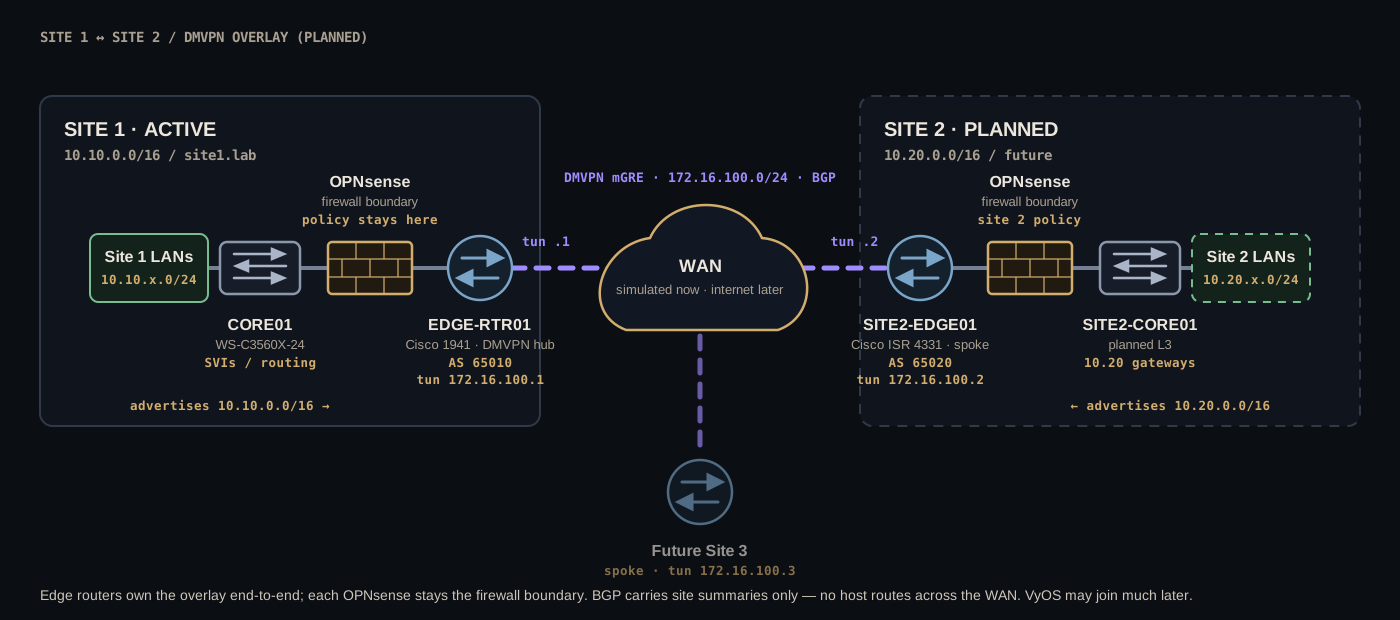
Overlay plan
Tunnel addressing
DMVPN overlay
  172.16.100.0/24

EDGE-RTR01    .1  Site 1
SITE2-EDGE01  .2  Site 2
future spoke  .3  Site 3
BGP plan
Site 1  EDGE-RTR01
  Cisco 1941 · AS 65010

Site 2  SITE2-EDGE01
  Cisco ISR 4331 · AS 65020
Advertisements
Site 1 advertises
  10.10.0.0/16

Site 2 advertises
  10.20.0.0/16

Summaries only,
no host routes.
Packet walk
Site 2 to Site 1 service
Site 2 client
  → Site 2 core
  → Site 2 firewall
  → SITE2-EDGE01
  → DMVPN overlay
  → EDGE-RTR01
  → Site 1 firewall / core
  → allowed Site 1 service
Why edge routers own the overlay
DMVPN runs edge-to-edge on Cisco gear: the existing 1941 already owns the Site 1 edge (PBR/NAT), so the hub role lands there naturally, and a planned ISR 4331 becomes the Site 2 spoke on enterprise IOS-XE patterns. OPNsense stays cleaner as the security boundary at each site, and inter-site access gets allowed by service, not by broad site-to-site trust. VyOS may be introduced much later as an optional routing lab.
Site 2 addressing
Core segments
MGMT    10  10.20.10.0/24
USERS   20  10.20.20.0/24
SERVERS 30  10.20.30.0/24
TRANSIT 40  10.20.40.0/30
Lab and access
LAB      50  10.20.50.0/24
WIRELESS 60  10.20.60.0/24
ADMIN    70  10.20.70.0/24
BLACKHOLE 999  no SVI
Reserved hosts
SITE2-CORE01
  10.20.10.1

SITE2-PVE01
  10.20.10.10

SITE2-EDGE01
  WAN edge · IP TBD
  tun 172.16.100.2
Design choices to test
The chosen path: Cisco 1941 hub to ISR 4331 spoke for dynamic tunnel behavior, routing adjacency decisions, and hub/spoke patterns.
Good for policy testing and understanding how security boundaries change when sites become connected.
A possible much-later addition for low-cost routing practice, clean snapshots, and fast rebuilds — not the overlay owner.
Hardware path
Assign a confirmed mini-host (UM890 Pro or M1 Plus class) as SITE2-PVE01, then mirror the Proxmox VLAN-aware bridge model from Site 1.
Deploy a Cisco ISR 4331 as SITE2-EDGE01 for the WAN edge and DMVPN spoke, keeping tunnel behavior, BGP, and route policy visible on enterprise gear.
Keep OPNsense focused on security policy and inter-site access rules instead of making it own the overlay.
Build gates
Site 1 core routing is stable, the OPNsense baseline policy is documented, monitoring and logging are live enough to observe routing changes, AUTO01/Ansible can back up network device configs, and the first Site 2 hardware role is confirmed.
Open questions
Which mini PC becomes SITE2-PVE01. Whether Site 2 needs local domain services or leans on Site 1 at first. Whether monitoring forwards to Site 1 or gets a small local collector. Whether VLANs 80 and 90 are reserved from day one.
Next steps